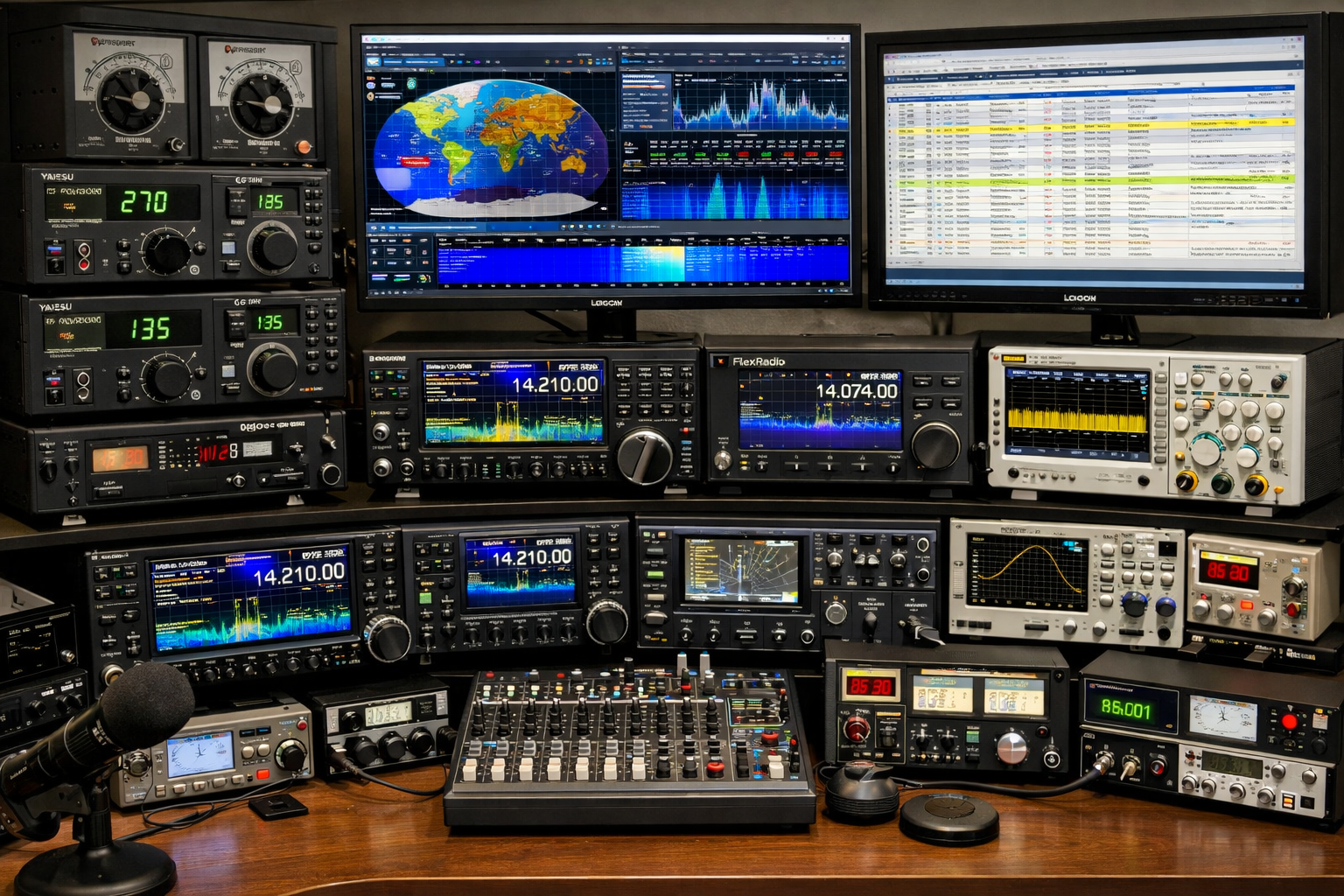
One of the original “Suspects”… still causing trouble on the bands
01/03/26 17:30
It didn’t start as a club.
Back in 2005, there was no grand plan, no charter, no officers sitting around a table deciding what this thing should become. It was just a few of us—Greg (N5XO), Bill (WX5W), and Ruth (KE5MHJ)—spending time on the air, experimenting with antennas, working a little HF, a little 6 meters, and enjoying the simple magic of radio. We called ourselves the Unusual Suspects, which fit about right. We weren’t trying to build anything formal. We were just having fun.
Most of our time back then was spent on a local repeater, like so many operators do when they’re getting going or just looking for easy conversation. It worked, it was familiar, and it kept us connected. But over time, that repeater began to struggle. Problems crept in, reliability dropped off, and eventually the club that supported it made the decision to decommission it.
For a lot of groups, that might have been the end of the story.
For us, it was the beginning.
Instead of fading away or scattering to other machines, we made a simple decision—we moved to simplex. No infrastructure, no safety net, just radios and antennas. We settled on 146.420 FM simplex, keyed up, and kept talking.
Something changed almost immediately.
There’s a different feel to simplex. It’s more direct, more personal. You’re not relying on a machine sitting on a tower somewhere—you’re reaching out, station to station, making it happen yourself. And for whatever reason, that resonated. Word started to spread. More operators found us. More voices joined in. What began as a handful of friends turned into a growing, active, and—most importantly—welcoming group.
We never lost sight of what mattered. From the very beginning, we made a conscious choice: this would not become another traditional club. No meetings to sit through. No officers. No dues. And absolutely no politics. We called it an UNCLUB, and we meant it. If you had a radio and a willingness to key up, you were already part of it.
As the years went on, something else began to take hold. A few of us—especially Jerry (KB2WDM) and myself—started drifting deeper into a different side of the hobby. We found ourselves tuning away from FM and toward the quiet edges of the bands—SSB and CW on VHF and UHF. What we discovered there changed everything.
Signals that barely moved the meter. Contacts that shouldn’t have been possible. Distances that completely rewrote what we thought those bands could do.
It wasn’t easy. It required better antennas, better understanding, more patience. But that challenge—that constant push to improve—was exactly what made it exciting.
By 2010, that passion had grown strong enough that we decided to give it a name of its own. Jerry and I formed what became the HAMsters Weak Signal Group, focused specifically on VHF/UHF simplex in its most challenging and rewarding form.
For a while, the Unusual Suspects and the HAMsters existed side by side. On paper, they were separate. In reality, they were the same people, the same friendships, the same voices on the air. It didn’t take long to realize what was obvious all along.
In 2012, we brought it all together.
The Unusual Suspects name was set aside, becoming part of our history, and from that point forward, we were simply the HAMsters.
The mission became clear, even if it was never formally written down. We were here to promote and grow VHF/UHF weak signal and FM simplex operating, to share what we had learned, to help others experience that same excitement—and to do it all without losing the easygoing, welcoming spirit that got us started in the first place.
Over the years, the group continued to grow. What began as a few voices on a repeater turned into a community of more than 200 operators, spreading across multiple states and even into other countries. Stations got better. Signals got farther. The contacts got more impressive. But the heart of it never changed.
We’re still that same group at our core.
Still welcoming the new operator who isn’t quite sure where to start. Still helping someone figure out why their antenna isn’t quite working right. Still celebrating that first weak signal contact like it’s a major accomplishment—because it is.
At the end of the day, it’s never really been about numbers or growth for its own sake. It’s about the experience. It’s about that moment when someone new hears a weak signal, makes the contact, and suddenly realizes there’s a whole new world sitting right there on the bands.
That’s what keeps this going.
That’s what makes it worth it.
And if you happen to stumble across us, key up, and join in—you’ll find out pretty quickly that you’re not really joining a club at all.
You’re just becoming part of the story.
Greg N5XO
Back in 2005, there was no grand plan, no charter, no officers sitting around a table deciding what this thing should become. It was just a few of us—Greg (N5XO), Bill (WX5W), and Ruth (KE5MHJ)—spending time on the air, experimenting with antennas, working a little HF, a little 6 meters, and enjoying the simple magic of radio. We called ourselves the Unusual Suspects, which fit about right. We weren’t trying to build anything formal. We were just having fun.
Most of our time back then was spent on a local repeater, like so many operators do when they’re getting going or just looking for easy conversation. It worked, it was familiar, and it kept us connected. But over time, that repeater began to struggle. Problems crept in, reliability dropped off, and eventually the club that supported it made the decision to decommission it.
For a lot of groups, that might have been the end of the story.
For us, it was the beginning.
Instead of fading away or scattering to other machines, we made a simple decision—we moved to simplex. No infrastructure, no safety net, just radios and antennas. We settled on 146.420 FM simplex, keyed up, and kept talking.
Something changed almost immediately.
There’s a different feel to simplex. It’s more direct, more personal. You’re not relying on a machine sitting on a tower somewhere—you’re reaching out, station to station, making it happen yourself. And for whatever reason, that resonated. Word started to spread. More operators found us. More voices joined in. What began as a handful of friends turned into a growing, active, and—most importantly—welcoming group.
We never lost sight of what mattered. From the very beginning, we made a conscious choice: this would not become another traditional club. No meetings to sit through. No officers. No dues. And absolutely no politics. We called it an UNCLUB, and we meant it. If you had a radio and a willingness to key up, you were already part of it.
As the years went on, something else began to take hold. A few of us—especially Jerry (KB2WDM) and myself—started drifting deeper into a different side of the hobby. We found ourselves tuning away from FM and toward the quiet edges of the bands—SSB and CW on VHF and UHF. What we discovered there changed everything.
Signals that barely moved the meter. Contacts that shouldn’t have been possible. Distances that completely rewrote what we thought those bands could do.
It wasn’t easy. It required better antennas, better understanding, more patience. But that challenge—that constant push to improve—was exactly what made it exciting.
By 2010, that passion had grown strong enough that we decided to give it a name of its own. Jerry and I formed what became the HAMsters Weak Signal Group, focused specifically on VHF/UHF simplex in its most challenging and rewarding form.
For a while, the Unusual Suspects and the HAMsters existed side by side. On paper, they were separate. In reality, they were the same people, the same friendships, the same voices on the air. It didn’t take long to realize what was obvious all along.
In 2012, we brought it all together.
The Unusual Suspects name was set aside, becoming part of our history, and from that point forward, we were simply the HAMsters.
The mission became clear, even if it was never formally written down. We were here to promote and grow VHF/UHF weak signal and FM simplex operating, to share what we had learned, to help others experience that same excitement—and to do it all without losing the easygoing, welcoming spirit that got us started in the first place.
Over the years, the group continued to grow. What began as a few voices on a repeater turned into a community of more than 200 operators, spreading across multiple states and even into other countries. Stations got better. Signals got farther. The contacts got more impressive. But the heart of it never changed.
We’re still that same group at our core.
Still welcoming the new operator who isn’t quite sure where to start. Still helping someone figure out why their antenna isn’t quite working right. Still celebrating that first weak signal contact like it’s a major accomplishment—because it is.
At the end of the day, it’s never really been about numbers or growth for its own sake. It’s about the experience. It’s about that moment when someone new hears a weak signal, makes the contact, and suddenly realizes there’s a whole new world sitting right there on the bands.
That’s what keeps this going.
That’s what makes it worth it.
And if you happen to stumble across us, key up, and join in—you’ll find out pretty quickly that you’re not really joining a club at all.
You’re just becoming part of the story.
Greg N5XO