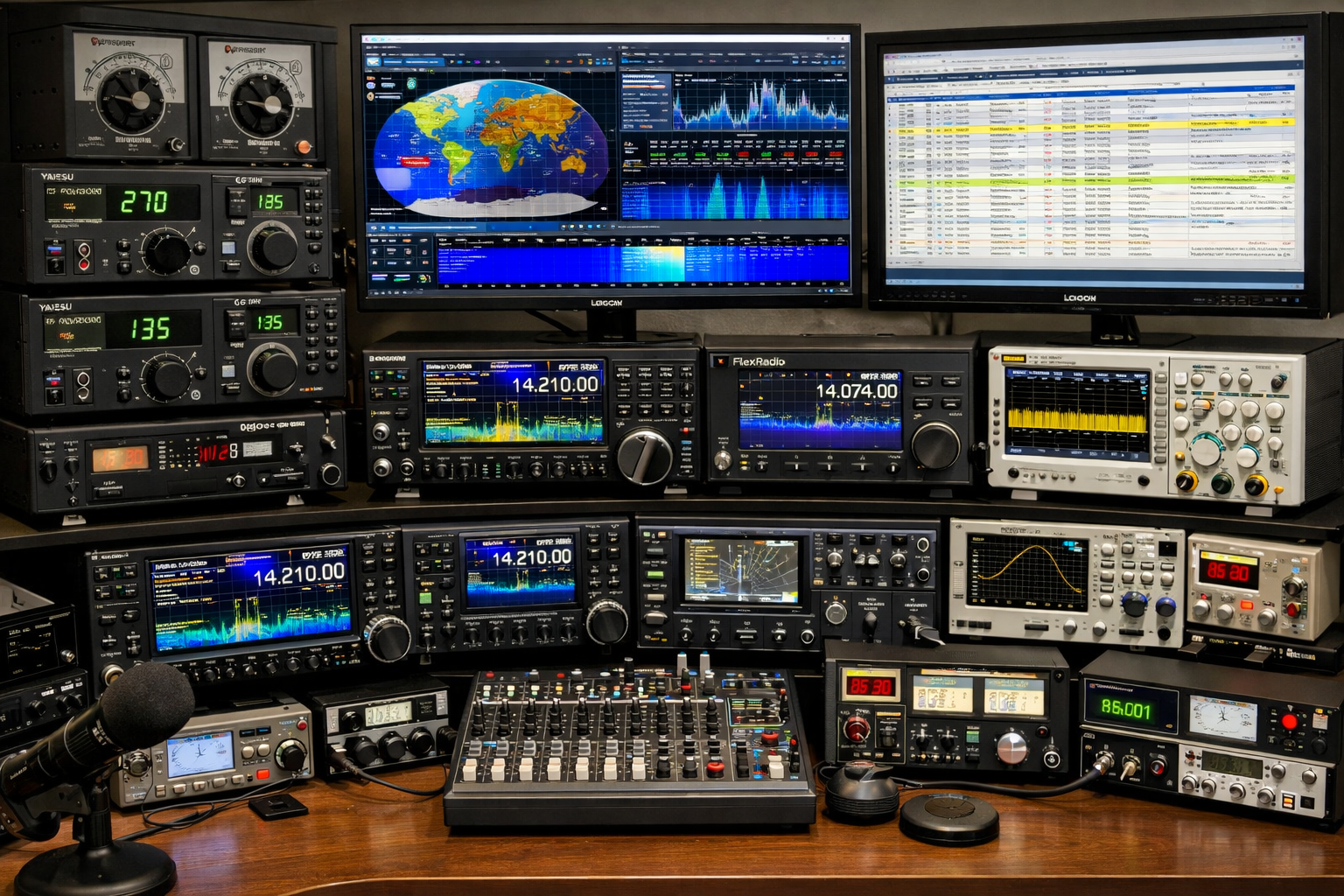
This is where the hobby shifts gears. Instead of short-range FM, you’re suddenly working stations 100, 200—even 500+ miles away on the same bands… with nothing but your station and your skill. SSB and CW let you hear—and be heard—right down near the noise floor. That weak signal you can barely copy? That’s the one that turns into a contact you’ll never forget. It’s not about big power—it’s about better antennas, smarter operating, and understanding propagation. And when it all comes together, the results will surprise you. If you’ve never tried it, you’re missing one of the most exciting parts of amateur radio. Tune to 144.200. Listen. Call CQ. You might be a lot farther away than you think.
utely — here is the WEAK SIGNAL version in the same embedded format, with bright neon green titles.
What is Weak Signal?
Weak Signal operation is the art of making long-distance contacts on VHF, UHF, and microwave bands using SSB, CW, digital modes, good antennas, and real operating skill.
📡 Beyond Local Range
Weak Signal opens the door to contacts far beyond normal FM range — 100, 200, 500 miles or more when conditions cooperate.
⚡ Different Than Simplex?
It is still station-to-station radio, just like simplex — but Weak Signal usually uses SSB, CW, or digital modes instead of FM, allowing much weaker signals to be copied over much greater distances.
🎯 Skill Matters
This is not just about power. Antennas, feedline loss, location, timing, beam heading, and operator patience all matter.
🌎 Real Propagation
Tropo, aircraft scatter, meteor scatter, sporadic E, and even Earth-Moon-Earth can turn quiet bands into serious long-distance paths.
How Weak Signal Works
SSB and CW
SSB and CW are far more effective than FM when signals are weak, making them ideal for long-distance VHF/UHF work.
Directional Antennas
Yagis, loops, and dishes focus your signal where it needs to go — and help pull tiny signals out of the noise.
Calling Frequencies
50.125 MHz – 6m SSB Calling
144.200 MHz – 2m SSB Calling
222.100 MHz – 1.25m SSB Calling
432.100 MHz – 70cm SSB Calling
1296.100 MHz – 23cm SSB Calling
Listen First
Weak Signal work rewards patience. Listen, watch conditions, point the antenna, and call when the band begins to open.
The Challenge Factor
Quiet Bands Aren’t Dead
Sometimes the band sounds empty — until someone calls CQ. Activity creates activity.
Station Building
Low-loss coax, clean audio, stable frequency control, and antennas that actually work make all the difference.
Operator Technique
Knowing where to point, when to call, how to listen, and how to work weak stations is the real art.
The Big Reward
That barely readable signal from several states away? That is the contact you remember.
Why It Matters
Weak Signal operation shows what VHF/UHF radio can really do. It combines science, skill, antennas, propagation, patience, and excitement into one of the most rewarding parts of Amateur Radio.
General Club Information:
Meetings:Last Saturday of Each Month; HAMster Meet & Greet Breakfast
8:am @
El Moicajete - 4404 Walzem Rd, San antonio, Tx 78218
First Monday of Each Month: Monthly Training & Meeting
6:30 PM at the San Antonio American Red Cross
Nets:
2 Meter Simplex Net
CQ-52 - 6;30 PM every Monday evening: 146.520 FM Simplex
2 Meter SSB Net
HAMster Net - 6:30 PM every Sunday evening: 144.180 USB
Repeaters:
N5XO - 147.120 DCS 131 - Pipe Creek
N5XO - 443.025 PL 82.5 - East San Antonio
Beacons:
N5XO - CW Beacon - 144.289
N5XO - CW Beacon - 432.360
N5XO - CW Beacon - 1296.420