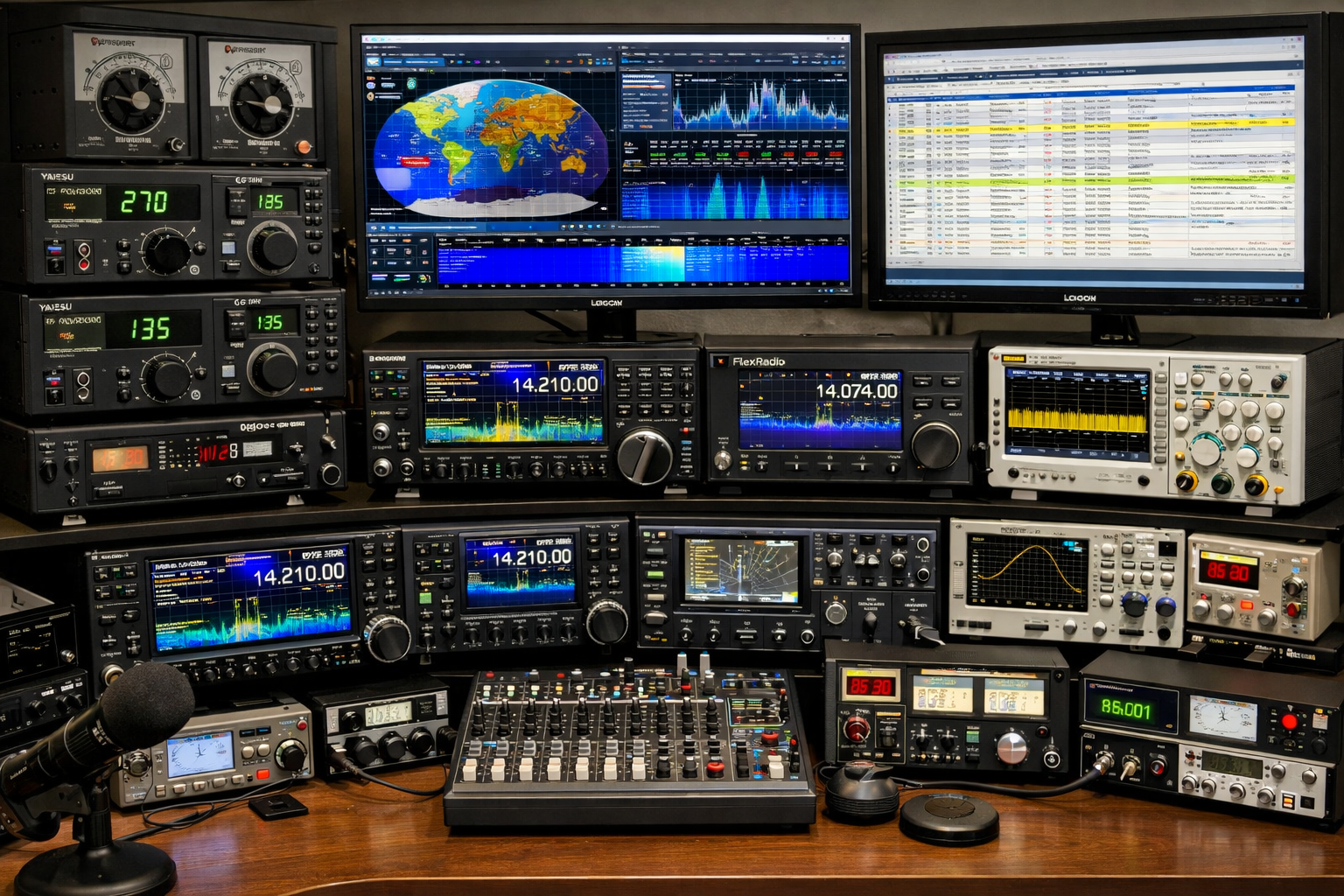
What is EME Moonbounce?
Not long ago, EME was considered “big gun” territory: huge antenna arrays, massive dishes, high power, and a lot of real estate. Today, modern digital modes, better receivers, low-noise preamps, and improved antennas have opened the door for smaller stations. Many operators can now get started with a single high-gain yagi or a reasonable-sized dish.
🌕 The Moon is the Reflector
Your signal travels to the Moon, reflects off its surface, and returns to Earth where another station receives it.
📡 Not Your Father’s EME
EME once required massive antenna farms. Today, digital modes and better equipment allow smaller, smarter stations to make real moonbounce contacts.
🎯 Precision Matters
The Moon is a small target in the sky. Antenna aiming, timing, low-loss feedline, and receiver sensitivity all matter.
⚡ The Big Reward
When that weak signal comes back from the Moon, you are not just making a contact — you are working another station through space.
How EME is Different
Simplex, But Extreme
EME is still station-to-station communication, just like simplex. The difference is the signal path goes from Earth, to the Moon, and back to Earth.
Very Weak Signals
By the time your signal returns, it is extremely weak. That is why EME depends on sensitive receivers, good antennas, and careful operating.
Digital Changed Everything
Modes like JT65 and Q65 allow operators to decode signals that would be impossible to copy by ear.
Still Real Radio
Even with digital help, EME is not automatic. Station design, antenna work, timing, and operating skill still make the contact happen.
Good Starter Bands for EME
2 Meters — 144 MHz
The most common beginner EME band. A serious starting station may use a single high-gain 2 meter yagi, low-loss coax, a good preamp, accurate antenna aiming, and enough power to be heard.
Best first target: 144 MHz EME using digital modes.
70 Centimeters — 432 MHz
A strong next step after 2 meters. Antennas are smaller than 2 meter antennas, but feedline loss becomes more important. A good yagi, mast-mounted preamp, and careful station setup matter.
Good balance of antenna size and performance.
23 Centimeters — 1296 MHz
A very practical microwave EME band. A reasonable-sized dish can provide serious gain, but feedline loss, preamp placement, frequency stability, and accurate pointing become critical.
Great choice for operators interested in dishes and microwave work.
Station Basics
For any EME band, think in terms of system performance: antenna gain, low-loss feedline, low-noise receive, clean transmit power, stable frequency control, and accurate Moon tracking.
What You Really Need to Learn
Antenna Gain
EME is about focusing energy. Higher gain antennas help transmit toward the Moon and receive the tiny signal coming back.
Low-Loss Feedline
Loss hurts twice — on transmit and receive. Keep feedline short, use quality coax, and place preamps near the antenna when possible.
Moon Tracking
You must know where the Moon is and point accurately. Azimuth and elevation control become part of the fun.
Patience
EME rewards operators who slow down, listen, test, adjust, and keep improving their station one piece at a time.
Why EME Matters
EME is one of the most amazing challenges in amateur radio. It combines weak-signal operating, antenna design, propagation, software, precision, and patience into one unforgettable experience.
You do not need to start with a monster station. Start by learning the basics, listening, understanding the equipment, and building toward that first contact. When it finally happens, you will remember it.